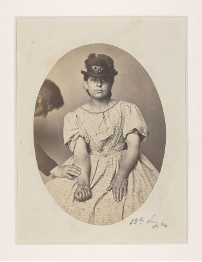
Who was, A young woman, sitting; she has a mark on the middle of her right arm, with her passive gaze fixed ahead at the photographer? Who is the man resting his fingers on her arm and bowing, as if to exit the image? What were the circumstances of the image’s creation?
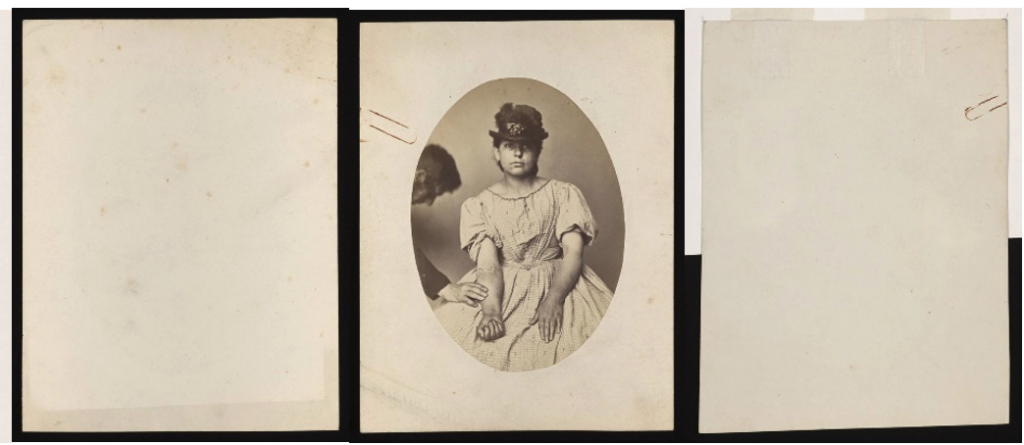
The photograph of a woman baring her arms in mid-Victorian era clothing wearing a hat was taken (according to an inscription on one copy) on 20 August 1864. The image was digitised (re-photographed) in the early 2000s to create an online copy. One of her arms has a mark on it and this arm is held lightly, as if to stabilise it, by a man, partially viewed. The original online image did not have the imprint of the, now removed, rusty paper clip on the left-hand on one of two copies held. When I encountered the actual prints in the Rare Materials’ Room in Wellcome Collection, I experienced cognitive dissonance between the online, sanitised version, and what I could see in front of me; albumen photoprints presenting over 100 years of wear and tear evident on the mounting and the reverse of the image. After taking reference images of the print, my own shadow was captured on the surface of the image by my phone camera – leading to thoughts about how lightly (or not) we tread upon the past and what traces we leave behind.
Wellcome holds 105 images (both pencil drawings and photographic prints) by orthopaedic clinician Heimann Wolff Berend (1809-1873) who was based in Berlin. In Berend’s published thesis of 1842, he described himself as a devotee of the Old Testament faith, being the son of his mother of Simonian race (Jewish Armenian heritage).[1] After some detective work by William Schupbach,[2] who at the time the material was accessioned had oversight of this material as Curator of Iconographic Collections, he established that the woman in the photograph was captured by Berend who had begun to use photography in his clinical practice from around 1852.
The pieces of the puzzle fell into place after researchers identified Berend, a key figure, being the first German clinician to systematically photograph patients before and after surgical treatment.[3] Berend engaged the studio of a well-known court photographer L. Haase & Co.[4] to take some of the photographs; their studio mark is printed on many of the mounts which has unsurprisingly led to confusion regarding the authorship of the material. If Haase or a studio photographer was behind the lens, then we can posit that it is Berend who has been captured with his patient, trying to the exit the frame. Later, the man might have been ‘air-brushed’ out to improve the aesthetics of the image.
Historical accounts indicate that Berend’s practice shifted from conventional medical illustration (pencil drawings, lithographs and woodcuts) to photography which had proved more versatile and scientific; photography being ‘…useful illustrations for the lectures I have repeatedly delivered.’ He was party to ‘the requests of many German and foreign physicians who were staying … during the winter of 1857 to pursue such specialized studies.’[5] In 1865, there had been a plan to publish, seemingly unfilled, an illustrated medical atlas using photography.[6]
A renewed appreciation of the photographs’ historical interest led to the proposal for their inclusion in an exhibition of early clinical photography in Germany in the early 2000s. All Berend’s images held by Wellcome were subject to conservation analysis to establish the photographic techniques used in their making (this report has been lost[7]). The working theory on how Wellcome Collection came upon the material is that the material was acquired by an orthopaedic physician, Edgar Cyriax (1874-1955)[8], given to the Royal Society of Medicine; disposed of by them; then rescued by two Wellcome librarians. Remaining today are only 97 photographs.
Studying the physical material, it is clear that during their lifetime, the photographs existed as an untidy pile allowing sunlight to partially fade the exposed paper on the back.
Who is the woman in the image captured on 13 August 1864 over 160 years ago? Berend treated many Jewish patients, and the dispersal of the photographs could have happened any time after Berend’s death – at the behest of fellow clinicians who followed his work, or via the rapid dispersal under conditions of war or persecution. We don’t know and perhaps never will.
Angela Saward
[1] Translated from the Latin from ‘Curriculum Vitae’ pp. 27-29BEREND, Heimann Wolff. Bericht (Zweiter Bericht) über das gymnastisch-orthopädische Institut zu Berlin, abgestattet von Dr. H. W. Berend. Berlin, 1842.
[2] Schupbach, William ‘The beginnings of clinical photography in Germany’, an unpublished draft, 20 August 2004.
[3] Schupbach, William, written response to a list-serv question raised on the History of the Health Sciences Forum 20 October 1995 in which the source of this information is Bruno Valentin’s article “Die Anfaenge der medizinischen Photographie, in Aerzteblatt Baden-Wurttemburg, Heft 8, August 1969
[4] https://www.npg.org.uk/collections/search/person/mp81799/l-haase–co
[5] Zu Wissenschaftlichen Zwecken eifrig benutzt Worden, und sie haben on namentlich für die Wiederholt Von mir gehaltenen Vortråge als nützliche Illustrationen gedient. Zu einer neuen Reihe solcher Vorträge, und Zwar in noch ausgedehnterer Weise, als dies früher selt dem Jahre 1853 (S . Med. Central-Zeitung. 1853. S. 231 u. 327) durch mich geschehen, fand [p. 4] ich besonders Veranlassung durch das Verlangen Vieler deutschen und ausländischen Aerzee, die zu solchen Special-Studien im Winter 1857 sich hierselbst aufhielten… translated by Google as ‘They have been used extensively for scientific purposes, serving notably as useful illustrations for the lectures I have repeatedly delivered. I found particular reason to undertake a new series of such lectures—and on a more extensive scale than I had previously done since 1853 (see *Med. Central-Zeitung*, 1853, pp. 231 and 327)—due to the requests of many German and foreign physicians who were staying here during the winter of 1857 for such specialized studies… (seventh) report, on p. 6, Berend mentions the Visit, 24 Jan. 1854, Bericht über das gymnastisch-orthopädische Institut zu Berlin / abgestattet von H.W. Berend. | Wellcome Collection
[6] Ibid, Report 12, 1865, p.16: “Die Herausgabe me ines photographischen Atlas steht bevor” translated by Google as “The publication of my photographic atlas is imminent.”
[7] The report mentions ‘eight different types of photographic processes represented in the Haase-Berend collection, but which also discusses the extreme fragility and poor condition of the photographs’ as cited in internal Wellcome correspondence 12 February 2001.
[8] Cyriax, Edgar Ferdinand (1874-1955) | Wellcome Collection