In the summer of 2022, I spent two weeks at the archives of the Center for the History of Medicine at the Countway Library, Harvard University, working with the collection of glass plate negatives from the Parisian hospital La Salpêtrière, taken between 1882 and the 1940. Some of the images taken in the late nineteenth century at the Salpêtrière are well-known today. However, this collection forced me to look at this photographic production in a different way, not just because they are negatives, so the images are very different, but mainly because of their materiality.
Glass plates are fragile objects. They can break, and their emulsion can peel off, so I had to work slowly, taking my time to handle each glass plate negative with care. As I unwrapped each plate, put in on the light box, photographed it, wrapped it again and put it back in its box, the fragility of the plates started to point towards the fragility of the subjects depicted in them.
This was particularly evident in the broken plates.
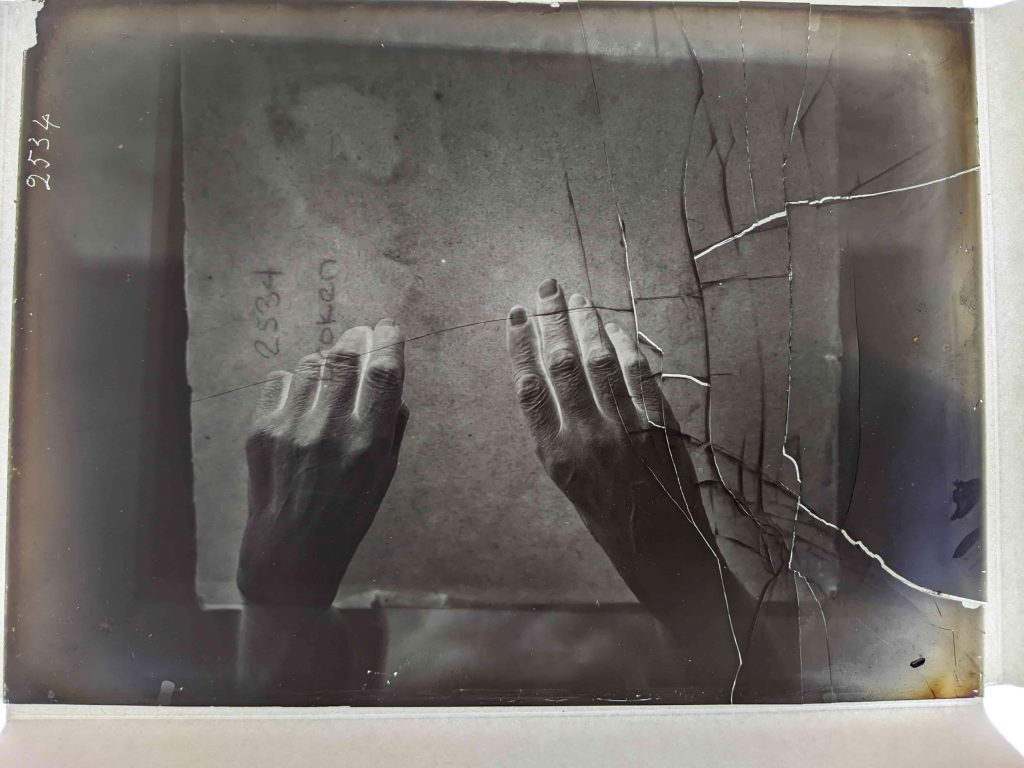
In this 1897 glass plate negative with several cracks on the right side, the plate number (2534) and the word “broken” can be seen through the image, just above the left hand. Cracks on glass plate negatives are very common, particularly in collections that have only been properly stored in recent years. The cracks on this plate are material signs of the life of the plate and how it has been cared for. But the content of these plates adds new meanings to these cracks. The cracks and the writing underneath made the plates look almost poetic, as the patient’s hands seem to avoid the cracks and the writing, pointing upwards, trying to touch something that remains out of reach. The word “broken” sits ambiguously between the plate and the patient. Handling these plates with care to avoid further damage, I felt compelled to handle the people in them with care.
A material encounter led to an ethical reflection about who cares (and cared) for the people in these photographs, and how that care was performed.
Beatriz Pichel