It is September 2026. The latest edition of the European Journal for the History of Medicine and Health has just been released. On its cover is a photograph of a man and a child, in a scene that suggests a dental practice. The adult dons the attire and actions of dentist – face cast down, hands wielding metal instruments, directing his attention into the mouth of his young patient. It appears staged for this photographic moment, captured by commercial and art photographer, Gordon Costor, in 1945.
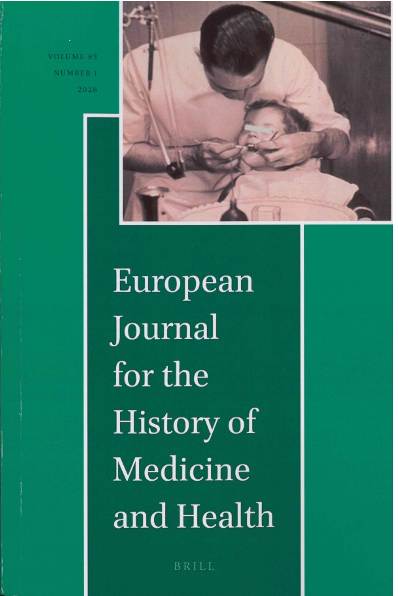
This is a fairly innocuous scene, except for one aspect: placed across the eyes of the child is a narrow white bar, inserted as a masking technique. While aimed to anonymise the young patient, the effects of the bar extend beyond this. The flattened uniform shape is jarring, small but biting, cutting across the child’s face. It obscures their facial expression, making their experience indecipherable. Are they in pain? Is this happening against their will? Are we not supposed to look?
When accessing the uncensored image (available online through the National Library of Medicine) the child’s face is freely on display. They look up at the dentist and appear neither particularly pained nor scared. The encouter reads as relatively banal: medical (yes), intimate (perhaps), strained (a little), forceful (not particularly). The impression given by the censored image – that this is a moment of physical violence – feels unfounded, hollow.
Instead of erasing information, the white bar can be seen to actively generate interpretation. In obscuring the child’s eyes, it directs our gaze towards them – inciting associations of war-time victims, anonymous suspects, and the desperately ill. The white bar incites us to look differently, inviting the viewer to imagine suffering or danger where the original does not. What Is instended as a protective act thus also produces a spectacle.
Michaela Clark